I have been working in the workshop producing curtain tracks for three years now. When I first started working with these products, I thought curtain tracks were actually quite simple. An aluminum track, together with some rollers and mounting accessories, could make up a complete curtain track system. There didn’t seem to be much technical detail involved.
However, after working with them for a while, I realized that curtain tracks may look simple, but there are many details that can affect the actual user experience. Things like load capacity, noise level, track size, durability, and smooth operation all matter.
And there is one question customers often ask: Is a curtain track better with a plastic strip inside, or without one? Maybe many people have had the same question.
So I would like to discuss this from the perspective of someone who has been involved in production and actual use for several years.
First, What Is a Curtain Track?
A curtain track is a type of hardware installed above a window to hang and move curtains. Aluminum is one of the most common materials, although some curtain tracks also use plastic components. Curtain tracks are available in different structures and sizes for different applications.
Depending on the installation method and application, there are standard exposed curtain tracks, slim curtain tracks, recessed curtain tracks, motorized curtain tracks, curved tracks, and tracks designed for special window conditions.
For curtain shops, designers, and installers, a track is not simply about whether it can be installed. Once installed, the curtain may be opened and closed every day. Whether it moves smoothly, how much noise it makes, and how much weight it can carry will gradually become noticeable.
How Have Curtain Tracks Evolved?
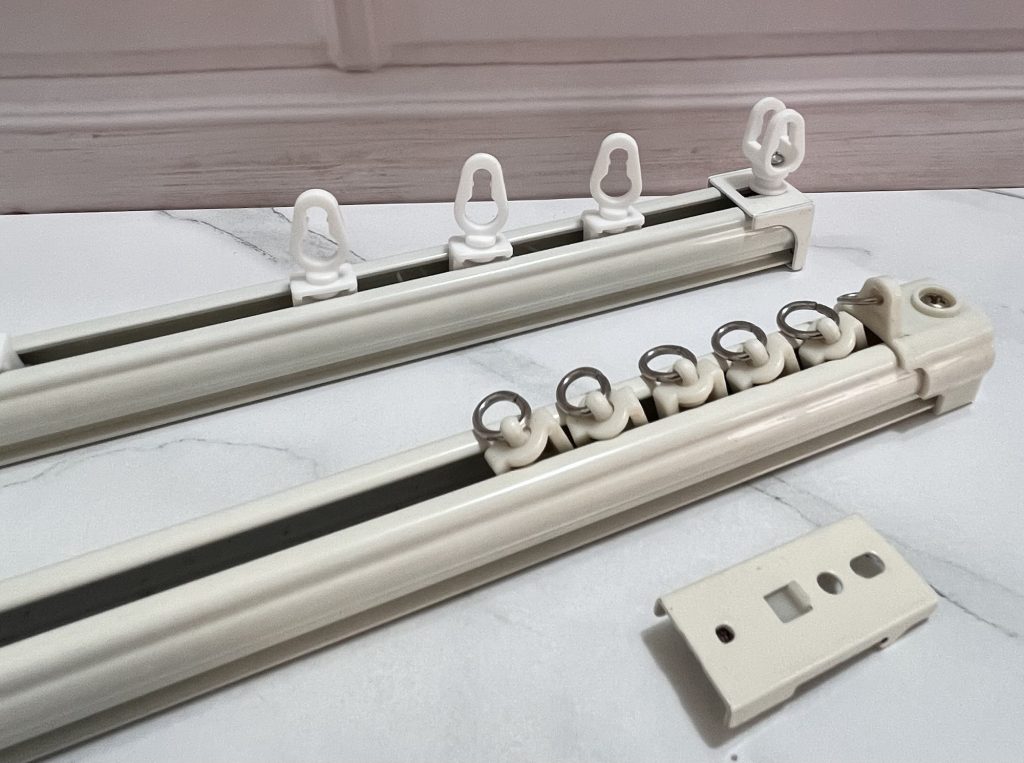
Early curtain tracks had relatively simple structures. Their main purpose was to hang curtains and allow them to move from side to side.
As residential and commercial projects began to have higher requirements for appearance, quiet operation, and limited installation space, curtain track designs also started to change.
Today, some tracks are made narrower and thinner. Some can be concealed inside the ceiling or curtain box, while others can be equipped with motors and controlled by remote controls or smart-home systems.
These changes are mainly responses to different application requirements.
From a production point of view, I don’t think a curtain track needs to be more complicated just for the sake of being complicated. What matters is where it will be installed, what type of curtain it will carry, and how frequently it will be used.
Is a Curtain Track Better With a Plastic Strip or Without One?
There is no single answer that applies to every curtain track.
Some curtain tracks have a plastic strip or plastic sliding component inside. Depending on the design, it can help reduce direct contact between metal parts, making the movement of the rollers softer and quieter. It can also provide some additional noise reduction.
However, a curtain track without a plastic strip is not necessarily a bad product.
Many tracks rely on the aluminum profile design, roller material, internal track dimensions, and machining accuracy to achieve smooth operation.
For heavier-duty curtain tracks, the aluminum profile may need to be thicker and stronger. In some designs, adding a plastic strip may not be the most suitable choice for carrying heavier curtains.
After spending some time in production, I realized that the actual performance of a curtain track cannot be judged simply by asking whether it has a plastic strip.
The aluminum profile, rollers, internal space, machining accuracy, and overall fit all need to work together.
So when purchasing curtain tracks, instead of only asking, “Does it have a plastic strip?” I think it is more useful to look at the complete track structure and the actual application.
Curtain Track Load Capacity Is Not Only About the Track
Load capacity is one of the things buyers often care about when purchasing curtain tracks.
Heavy blackout curtains, velvet curtains, and large floor-to-ceiling curtains place higher requirements on both the track and the installation method.
The aluminum structure, profile thickness, number of rollers, spacing of the mounting brackets, and the way the track is fixed to the wall or ceiling can all affect the final load capacity.
That is why the same curtain track may perform differently depending on how it is installed.
In our production work, we don’t only look at the aluminum profile itself. We look at the track, rollers, and accessories as a complete system. This gives us a more realistic idea of how the whole structure will perform.
How Does the Plastic Strip Affect Curtain Track Noise?
Many people think that if a curtain track has a plastic strip inside, it must be a quiet track.
In actual production, it is not that simple.
The noise produced when a curtain is pulled can come from the contact between the rollers and the track. It can also be affected by the roller material, curtain weight, installation method, and the way the track is loaded.
If the rollers do not run smoothly, simply adding a plastic component cannot solve every noise problem.
That is why we usually pay more attention to whether the rollers move steadily and whether the internal dimensions of the track are properly matched.
For bedrooms, hotels, and some higher-end residential projects where quiet operation is important, these details are worth paying attention to.
Curtain Track Size: Bigger Is Not Always Better
In the past, some buyers thought that a wider and thicker curtain track would automatically have better load capacity.
But window designs and interior spaces are becoming more varied. Sometimes there is very little space above a window.
For example, with inward-opening windows, a track that is too thick may interfere with the window.
This is one reason why slim and narrow curtain tracks have become more common.
The track size should be selected according to the curtain weight, installation position, and available space.
Large curtains may require a stronger structure, while smaller installation spaces may be better suited to a lightweight and slim track. These smaller tracks often do not use a plastic strip.
Curtain Track Durability Is Something Many Buyers Care About
A curtain track may work normally when it is first installed. The real difference often becomes clearer after it has been used for some time.
A curtain that is opened and closed dozens of times every day has different requirements from one that is only used occasionally.
The aluminum profile, roller material, surface treatment, installation method, and quality of the accessories can all affect long-term durability.
If the track structure is properly designed, the rollers work steadily, and the installation is done correctly, the possibility of problems such as sticking or deformation can generally be reduced.
If a plastic strip is used, its long-term aging should also be considered, especially in applications with frequent use or specific environmental conditions.
Smooth Operation Is One of the Easiest Details to Overlook
As someone working in production, when I look at a curtain track today, my first thought is not whether it has a plastic strip.
I first look at how the rollers actually move inside the track.
Curtains are opened and closed every day. If a track feels smooth at the beginning but develops resistance after moving a certain distance, the difference will be noticeable in daily use.
A good curtain track should allow the curtain to move steadily under its normal load.
Long tracks, curved tracks, and tracks carrying heavier curtains place even higher requirements on the matching between the rollers and the track.
Finally: With a Plastic Strip or Without One?
After three years of working in curtain track production, I would not simply say that one type is always better than the other.
A curtain track with a plastic strip can, depending on its design, provide benefits such as reduced friction and noise. A track without a plastic strip can also achieve smooth operation through its aluminum profile design, roller design, and machining accuracy.
For wholesale buyers, I think the more practical approach is to start with the actual project requirements:
How heavy are the curtains?
How long does the track need to be?
How much installation space is available?
How frequently will the curtains be used?
How important is quiet operation?
Once these questions are clear, it becomes easier to decide whether a curtain track with or without a plastic strip is more suitable.
In the end, comparing only one small plastic component is not as meaningful as looking at the complete track system.
Customer requirements are what we should really focus on.
After all, a curtain track is a product that people use every day.
As production workers, we look at the aluminum profile, rollers, and accessories. Installers pay attention to how easy the track is to install. And the final user notices whether the curtain moves smoothly, whether it is noisy, and whether the track remains stable without bending during use.
After three years in production, this is probably the biggest thing I have learned: different applications require different curtain track designs.
I have been working in the workshop producing curtain tracks for three years now. When I first started working with these products, I thought curtain tracks were actually quite simple. An aluminum track, together with some rollers and mounting accessories, could make up a complete curtain track system. There didn’t seem to be much technical detail involved.
However, after working with them for a while, I realized that curtain tracks may look simple, but there are many details that can affect the actual user experience. Things like load capacity, noise level, track size, durability, and smooth operation all matter.
And there is one question customers often ask: Is a curtain track better with a plastic strip inside, or without one? Maybe many people have had the same question.
So I would like to discuss this from the perspective of someone who has been involved in production and actual use for several years.
First, What Is a Curtain Track?
A curtain track is a type of hardware installed above a window to hang and move curtains. Aluminum is one of the most common materials, although some curtain tracks also use plastic components. Curtain tracks are available in different structures and sizes for different applications.
Depending on the installation method and application, there are standard exposed curtain tracks, slim curtain tracks, recessed curtain tracks, motorized curtain tracks, curved tracks, and tracks designed for special window conditions.
For curtain shops, designers, and installers, a track is not simply about whether it can be installed. Once installed, the curtain may be opened and closed every day. Whether it moves smoothly, how much noise it makes, and how much weight it can carry will gradually become noticeable.
How Have Curtain Tracks Evolved?
Early curtain tracks had relatively simple structures. Their main purpose was to hang curtains and allow them to move from side to side.
As residential and commercial projects began to have higher requirements for appearance, quiet operation, and limited installation space, curtain track designs also started to change.
Today, some tracks are made narrower and thinner. Some can be concealed inside the ceiling or curtain box, while others can be equipped with motors and controlled by remote controls or smart-home systems.
These changes are mainly responses to different application requirements.
From a production point of view, I don’t think a curtain track needs to be more complicated just for the sake of being complicated. What matters is where it will be installed, what type of curtain it will carry, and how frequently it will be used.
Is a Curtain Track Better With a Plastic Strip or Without One?
There is no single answer that applies to every curtain track.
Some curtain tracks have a plastic strip or plastic sliding component inside. Depending on the design, it can help reduce direct contact between metal parts, making the movement of the rollers softer and quieter. It can also provide some additional noise reduction.
However, a curtain track without a plastic strip is not necessarily a bad product.
Many tracks rely on the aluminum profile design, roller material, internal track dimensions, and machining accuracy to achieve smooth operation.
For heavier-duty curtain tracks, the aluminum profile may need to be thicker and stronger. In some designs, adding a plastic strip may not be the most suitable choice for carrying heavier curtains.
After spending some time in production, I realized that the actual performance of a curtain track cannot be judged simply by asking whether it has a plastic strip.
The aluminum profile, rollers, internal space, machining accuracy, and overall fit all need to work together.
So when purchasing curtain tracks, instead of only asking, “Does it have a plastic strip?” I think it is more useful to look at the complete track structure and the actual application.
Curtain Track Load Capacity Is Not Only About the Track
Load capacity is one of the things buyers often care about when purchasing curtain tracks.
Heavy blackout curtains, velvet curtains, and large floor-to-ceiling curtains place higher requirements on both the track and the installation method.
The aluminum structure, profile thickness, number of rollers, spacing of the mounting brackets, and the way the track is fixed to the wall or ceiling can all affect the final load capacity.
That is why the same curtain track may perform differently depending on how it is installed.
In our production work, we don’t only look at the aluminum profile itself. We look at the track, rollers, and accessories as a complete system. This gives us a more realistic idea of how the whole structure will perform.
How Does the Plastic Strip Affect Curtain Track Noise?
Many people think that if a curtain track has a plastic strip inside, it must be a quiet track.
In actual production, it is not that simple.
The noise produced when a curtain is pulled can come from the contact between the rollers and the track. It can also be affected by the roller material, curtain weight, installation method, and the way the track is loaded.
If the rollers do not run smoothly, simply adding a plastic component cannot solve every noise problem.
That is why we usually pay more attention to whether the rollers move steadily and whether the internal dimensions of the track are properly matched.
For bedrooms, hotels, and some higher-end residential projects where quiet operation is important, these details are worth paying attention to.
Curtain Track Size: Bigger Is Not Always Better
In the past, some buyers thought that a wider and thicker curtain track would automatically have better load capacity.
But window designs and interior spaces are becoming more varied. Sometimes there is very little space above a window.
For example, with inward-opening windows, a track that is too thick may interfere with the window.
This is one reason why slim and narrow curtain tracks have become more common.
The track size should be selected according to the curtain weight, installation position, and available space.
Large curtains may require a stronger structure, while smaller installation spaces may be better suited to a lightweight and slim track. These smaller tracks often do not use a plastic strip.
Curtain Track Durability Is Something Many Buyers Care About
A curtain track may work normally when it is first installed. The real difference often becomes clearer after it has been used for some time.
A curtain that is opened and closed dozens of times every day has different requirements from one that is only used occasionally.
The aluminum profile, roller material, surface treatment, installation method, and quality of the accessories can all affect long-term durability.
If the track structure is properly designed, the rollers work steadily, and the installation is done correctly, the possibility of problems such as sticking or deformation can generally be reduced.
If a plastic strip is used, its long-term aging should also be considered, especially in applications with frequent use or specific environmental conditions.
Smooth Operation Is One of the Easiest Details to Overlook
As someone working in production, when I look at a curtain track today, my first thought is not whether it has a plastic strip.
I first look at how the rollers actually move inside the track.
Curtains are opened and closed every day. If a track feels smooth at the beginning but develops resistance after moving a certain distance, the difference will be noticeable in daily use.
A good curtain track should allow the curtain to move steadily under its normal load.
Long tracks, curved tracks, and tracks carrying heavier curtains place even higher requirements on the matching between the rollers and the track.
Finally: With a Plastic Strip or Without One?
After three years of working in curtain track production, I would not simply say that one type is always better than the other.
A curtain track with a plastic strip can, depending on its design, provide benefits such as reduced friction and noise. A track without a plastic strip can also achieve smooth operation through its aluminum profile design, roller design, and machining accuracy.
For wholesale buyers, I think the more practical approach is to start with the actual project requirements:
How heavy are the curtains?
How long does the track need to be?
How much installation space is available?
How frequently will the curtains be used?
How important is quiet operation?
Once these questions are clear, it becomes easier to decide whether a curtain track with or without a plastic strip is more suitable.
In the end, comparing only one small plastic component is not as meaningful as looking at the complete track system.
Customer requirements are what we should really focus on.
After all, a curtain track is a product that people use every day.
As production workers, we look at the aluminum profile, rollers, and accessories. Installers pay attention to how easy the track is to install. And the final user notices whether the curtain moves smoothly, whether it is noisy, and whether the track remains stable without bending during use.
After three years in production, this is probably the biggest thing I have learned: different applications require different curtain track designs.