Dear friends in the window covering industry, hello everyone.
I’m Lao Tan, the technical lead in charge of product development for this project. Today’s launch event won’t beat around the bush — we’ll get straight to a new product we’ve just brought to life: the aluminum alloy bottom-slide Roman rod.
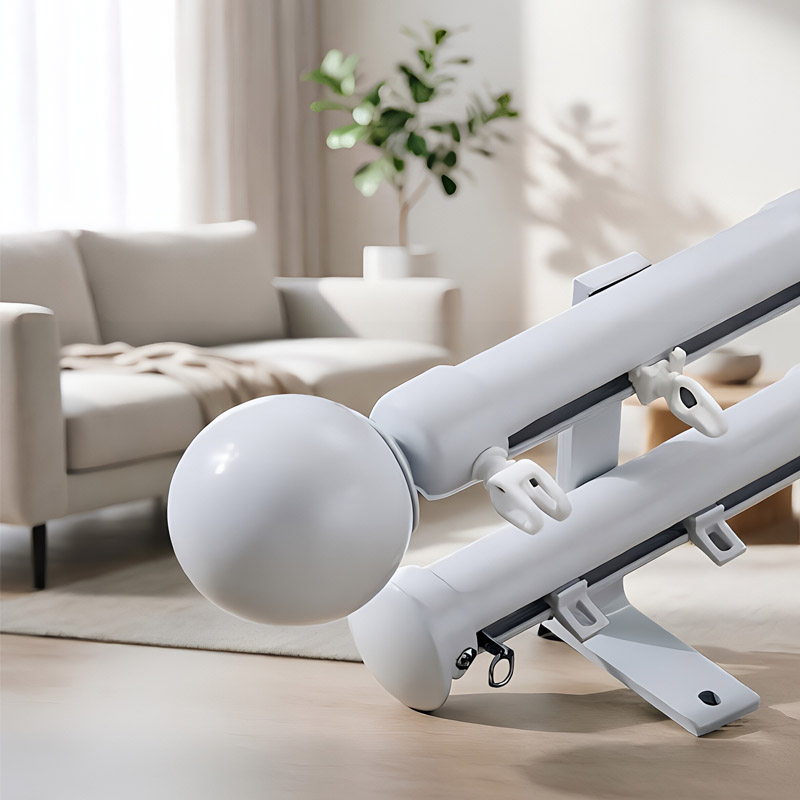
After working in the window covering and curtain industry for so long, we often run into a dilemma: you want the decorative, artistic feel of a Roman rod, but you can’t stand how stiff it feels when you pull it; or you want the smoothness and single-panel look of a track, but you feel a track with both ends exposed isn’t decorative enough. This is especially true for large windows that span an entire wall — a Roman rod must have a bracket in the middle, and once you add a bracket, the curtain has to be split into sections. A perfectly good single curtain gets cut into several pieces, which looks awkward no matter how you look at it.
The bottom-slide Roman rod we’ve made this time is meant to solve exactly this problem.
Let’s start with the appearance. Its shape is still that of a Roman rod, with a diameter of 28mm and a wall thickness of 1.5mm. This wall thickness wasn’t chosen at random — too thin and it can’t bear enough weight; too thick and it becomes bulky. 1.5mm is the value we found to be the most balanced after repeated testing. It won’t sag or deform even when hanging heavy curtains. At the same time, it offers strong cost-effectiveness in the market. As for color, we’ve stuck with the mainstream classics: currently there are two basic colors, black and white. Black is steady and understated, white is clean and fresh — they can basically match most home decor styles.
Today, let’s analyze its core — it’s not in the rod itself, but in the bottom-slide structure. We’ve made it into a pulley system similar to a track. From the outside, it still looks like a Roman rod; both ends are fully decorated with artistic rod finials. When you pull it by hand, the feel is the smoothness of a track. The pulleys are hidden beneath the rod body, and the rollers glide with almost no noise. This means you no longer have to compromise on smoothness by choosing a product that’s obviously a curtain track at a glance.
For installation, we’ve made a very practical change. Brackets can be added at unlimited distances. Why were Roman rods afraid of length in the past? Because when they got long, a bracket had to be added in the middle, and once a bracket was added, the curtain had to be split into two panels. Now this problem no longer exists. You can add as many brackets as you want — the brackets are only responsible for load-bearing and don’t interfere with the continuity of the curtain. A curtain spanning an entire wall can be pulled all the way as a single panel without breaking in the middle, or it can be made into 2 or 3 panels according to your preference. The degree of freedom of choice is high.
In terms of load-bearing, because the rod body itself is thick and solid, combined with the cooperation of multiple brackets, hanging heavier fabrics like velvet or blackout cloth is no pressure at all. We’ve tested it — for normal household use, you don’t need to worry about sagging or jamming. You can use it with confidence.
For the decorative finials on both ends, the default standard options are a round head and a small end cap. The round head leans classic, the small end cap leans minimalist. If you have more ideas, you can also switch to other styles of decorative finials — we’ve left an interface, and more new head styles will be released one after another. This depends on personal preference; we won’t make the decision for you.
There’s one more thing I want to emphasize: it supports serpentine curtain rollers. What does that mean? It means you can use this rod to make serpentine curtains and wave curtains. Serpentine curtains have relatively high requirements for the track — the spacing and smoothness of the rollers directly determine whether the waves look good. Our bottom-slide structure has rollers specifically tuned for serpentine curtains. When pulled, the waves are even, and you won’t get a situation where one part is bunched up and another part is pulled flat. Whether you make Korean-style pleated curtains or wave curtain designs, it’s an excellent choice.
With all the features above, let me summarize. The bottom-slide Roman rod: the exterior is a Roman rod, the interior is a track. Length can be customized, diameter 28mm, wall thickness 1.5mm, black and white available. Brackets can be added freely, curtains don’t need to be split into panels. Decorative finials are interchangeable, it can hang all kinds of curtains, and it can also make serpentine curtains. Enough load-bearing, enough smoothness.
If you’ve been hesitating between a Roman rod and a track, this product is made for exactly that hesitation.
Whether you’re in window covering wholesale, curtain supply, or you run a curtain shop, soft furnishing showroom, or you’re a designer — you can let customers choose according to their preferences and add this different new trend in window decoration.