When customers choose curtain tracks for wave curtains, skyline curtains, and other modern curtain styles, many people first look at the appearance of the track. But from our years of experience in the production workshop, we know that the track is only one part of the whole system.
The runner spacing, curtain tape, hooks, and whether the track needs to be curved can all affect the final curtain effect. In actual production, we usually pay more attention to the specific project and installation conditions.
What Is the Difference Between Wave Curtains and Korean Pleat Curtains?
Wave curtains and Korean pleat curtains can look quite similar, but they are made in different ways.
Wave curtains normally use connected runners with fixed spacing. The fabric follows the runners and forms continuous, regular waves. The overall look is clean and modern.
Korean pleat curtains use a different pleating structure. The fabric forms individual pleats rather than the continuous wave effect of a wave curtain. The spacing between the pleats is usually a little more relaxed.
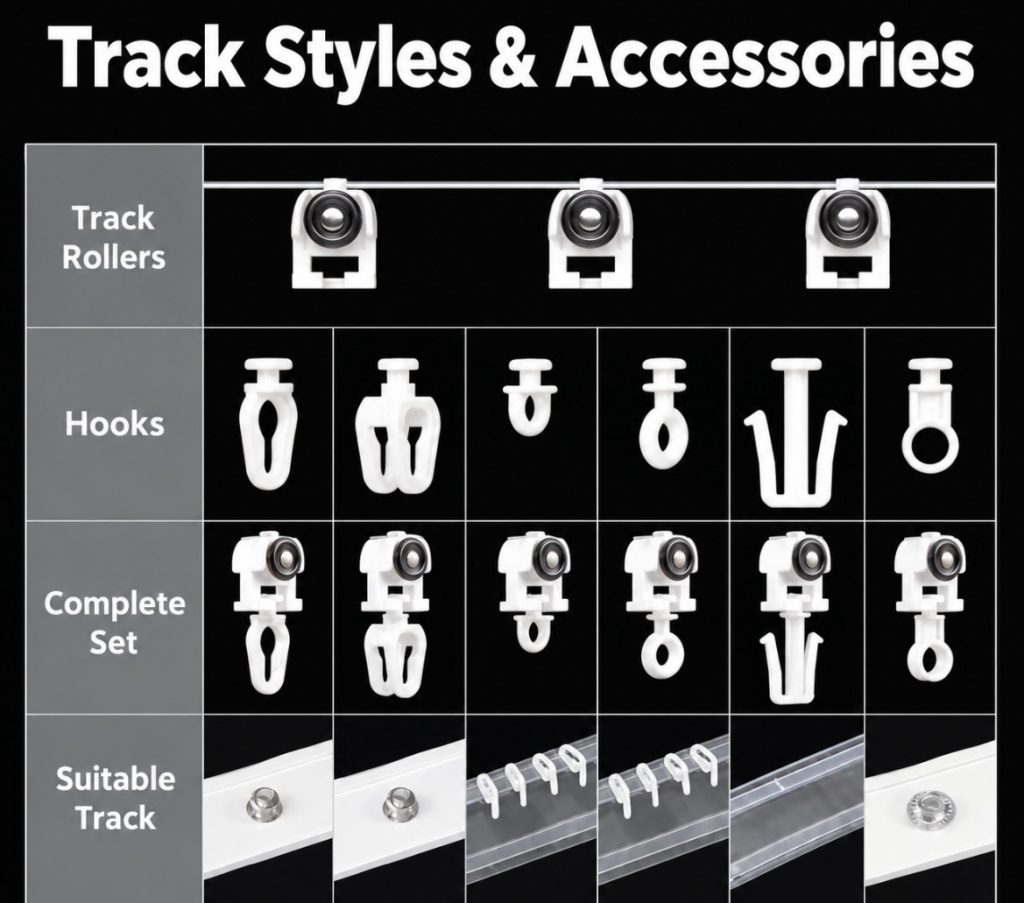
So when choosing curtain track accessories, the first step is to decide which curtain style you are making. A track and accessory system designed for one style cannot simply be expected to produce the same effect with another style. Once this is clear, the rest becomes much easier.
Wave Curtain Runners: Straight Track or Curved Track?
For wave curtains, we commonly see two types of runners.
The first is the standard straight-track type. It is mainly used for normal straight window installations. The structure is simple and practical for many regular projects, while also giving the finished curtain a clean and more premium appearance.
The second is the curved-track type. If the project has a bay window, corner, or curved area, we need to consider how the runners will move through the curve. Using runners designed for curved tracks can make the curtain operate more smoothly.
This is one of those details that needs to be considered according to the actual installation location.
Runner Spacing: 60mm, 70mm or 80mm?
The spacing between the runners also makes a difference. Different spacing creates different levels of wave density.
Common options include:
- 60mm
- 70mm
- 80mm
Generally, smaller spacing creates denser waves, while larger spacing creates a more open and relaxed wave effect.
Of course, runner spacing should not be considered by itself. The curtain fabric and fullness also need to be considered.
For example, larger windows may work well with a larger runner spacing, while smaller windows may be better suited to a smaller spacing. The actual fabric and design still need to be taken into account.
The Curtain Tape Is Also Important
The curtain tape is another important part of the system.
In production, we commonly work with different types of curtain tape, including:
- Reinforced woven tape
- Mesh tape
The tape is not simply sewn onto the back of the curtain. Its hook positions and spacing need to match the runners and hook system so that the whole system can work properly.
Common tape spacing options include 107mm, 125mm, and 145mm.
When a customer sends us a picture of the curtain they want to make, or a picture of their existing hardware, we normally check these details first. Then we can recommend the suitable track and accessories according to the actual application.
Skyline Curtains: Adjustable Hooks Give You More Flexibility
Another curtain style that is quite similar to wave curtains is the skyline curtain.
One interesting feature of the skyline system is the adjustable hook. Customers can adjust the hook according to their preferred curtain height and finished look.
From the production side, one detail we pay attention to is that the same runner base can be matched with different hook designs.
This gives customers more choices without having to change the basic runner base.
For curtain shops and installers, this can also make things easier. You can keep the same basic base and choose different hook styles according to the project.
Same Base, Different Hook Styles
This is a detail that is much easier to understand from a picture than from words.
[Insert image: Same runner base with different hook styles]
The base stays the same, while different hooks can create different installation and hanging options. Customers can choose according to their needs and preferences.
So, How Should You Choose?
There is no single curtain track that is suitable for every project.
Some choices depend on the customer’s preference, while others depend on the actual window and installation conditions.
If you are making a standard wave curtain, first check whether you need a straight track or a curved track. Then choose the runner spacing according to the desired curtain effect, such as 60mm, 70mm, or 80mm.
Next, consider the curtain tape and its spacing, such as 107mm, 125mm, or 145mm.
If you choose a skyline curtain, adjustable hooks can provide more flexibility for curtain height and installation.
From the production workshop’s point of view, we have always found one simple principle useful:
Do not choose the curtain track separately from the curtain-making system.
The track, runners, curtain tape, hooks, fabric, and installation method should all work together.
For curtain shops, installers, designers, and wholesale buyers, if you are not sure which system to choose, simply send us a picture of the curtain you want to make. That is often the easiest way to start.
We can first look at the curtain structure and then recommend suitable curtain tracks and accessories according to the actual requirements.
This helps us better match the customer’s needs and preferences.
For wholesale buyers, we also recommend keeping several options in stock when possible. Having different runner spacings, tape options, and hook styles available can make it easier to handle different customer projects.