Hey buddy, since you’re in home furnishings procurement, let’s cut to the chase. You’re asking me whether curtain rods are actually any good and whether they’re worth stocking up on in bulk? My answer is: this thing is like that veteran salesperson who’s been working in your curtain shop for ten years—looks unremarkable, but you really can’t do without her, and the customers would be the first to complain. But in bulk? It seems like you don’t really need that many.
1. Where Did It Actually Come From?
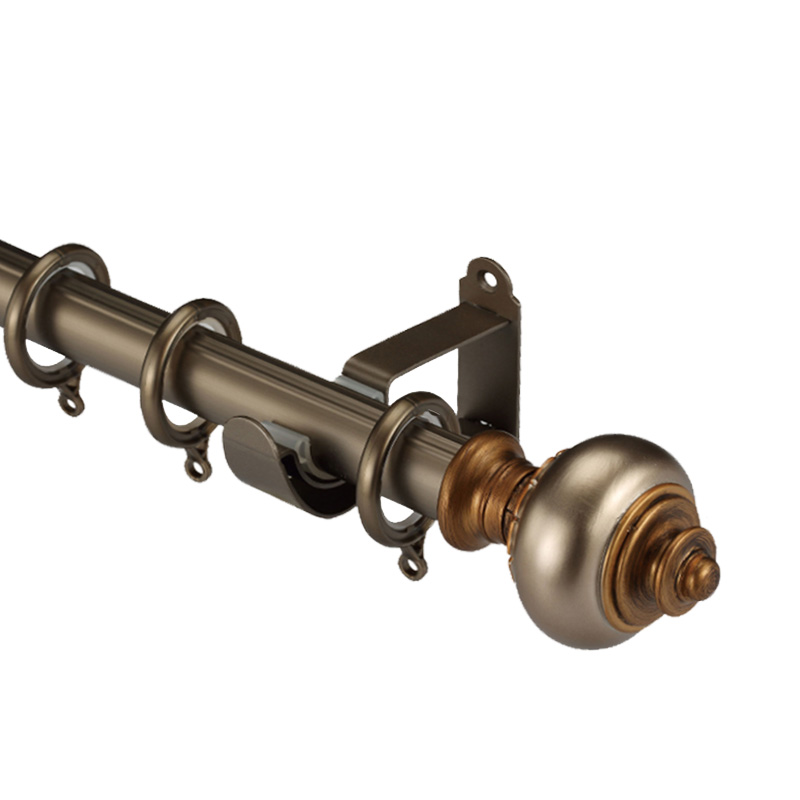
Don’t let the name “Roman rod” fool you. A lot of people think it has something to do with the Roman Colosseum, but that’s not the case at all. It got its name purely because the gourd-shaped decorative finials on both ends of the rod look like the capitals of ancient Roman architecture—and the name just stuck. Actually, there are many other finial shapes available too.
Simply put, it’s a “surface-mounted” curtain rod. The rod body is exposed, and it’s a decorative piece in itself—unlike tracks that hide timidly inside a curtain box. That’s also its biggest selling point: easy to install, easy to remove and wash. Just drill holes in the wall, secure it, and you’re done. No need to reserve a curtain box in advance. Most importantly, it gives curtains a beautiful, crisp fold.
2. Its Evolution from “Iron Gal” to “Aluminum Lightweight”
If you’d entered the industry ten years earlier, the Roman rods you got were most likely iron. Those things were genuinely sturdy—high hardness, resistant to deformation—but the downsides were obvious: heavy, expensive, clanging loudly when you pull the curtains, and limited in color options.
Then aluminum alloy rods came along—lightweight, more colors—and instantly grabbed the market. But aluminum alloy has a pitfall: insufficient hardness. If the wall thickness is too thin, it bends easily, and the rod will sag over time when hanging heavy velvet curtains. So when you’re sourcing aluminum alloy Roman rods now, the first thing to check is wall thickness. Good rods should have a wall thickness between 1.2mm and 1.5mm. Below that, it’s generally not recommended for heavy curtains. Iron rods can be made with diameters of 16-25mm, visually more “slender”; aluminum alloy rods are usually thicker, with 28mm being the most common spec on the market.
3. How to Choose Sizes? Don’t Let Customers Chase You with a Tape Measure
Common Roman rod diameters include 19mm, 22mm, 25mm, 28mm, and 30mm. 28mm is absolutely mainstream—it handles most household curtains. But if the customer wants grommet-style curtains (where the fabric has holes punched in it and slides directly onto the rod), 28mm or above is needed, and you’ll need special large rings, which increases cost.
For length: rod length = window width + 30cm on each side. That extra length allows the curtains to fully expose the glass when pulled open—otherwise the customer stands by the window feeling like they’re in a cage. Terrible experience. Also remember one number: if the rod length exceeds 2.2 meters, a center support bracket must be added, or it’ll eventually bend on you. As a procurement person, you absolutely need to know this.
4. Where Is It Suitable For?
Roman rods are typically “aesthetics-first”—suitable for spaces with not-too-high ceilings, no complex drop ceilings, and a desire for quick results. Bedrooms and living rooms use them most. Paired with cotton-linen or silk curtains, once the finials show, the decorative effect and style immediately stand out.
But for bay windows, L-shaped windows, and U-shaped windows—don’t recommend them. Roman rods don’t bend well; at corners, you can only splice segments, which is ugly and hard to use. For these scenarios, honestly recommend curved tracks—smooth and easy to use.
One more thing you must clarify with customers in advance: Roman rods have a slight light leak at the top. This is a physical characteristic of surface-mounted rods, not a quality issue. North-facing rooms or living rooms are usually fine. If the customer is obsessed with blackout, suggest installing it higher.
If you want to wholesale and procure Roman rods, you need to be familiar with all of this. Got it?