Many people face a dilemma when choosing curtain tracks: should I pay a bit extra for a silent strip, and is it really worth it? Today, from the perspective of someone working in the industry, I’ll break down both types of tracks in detail—no exaggeration, no bias. After reading this, you’ll have a clear picture.
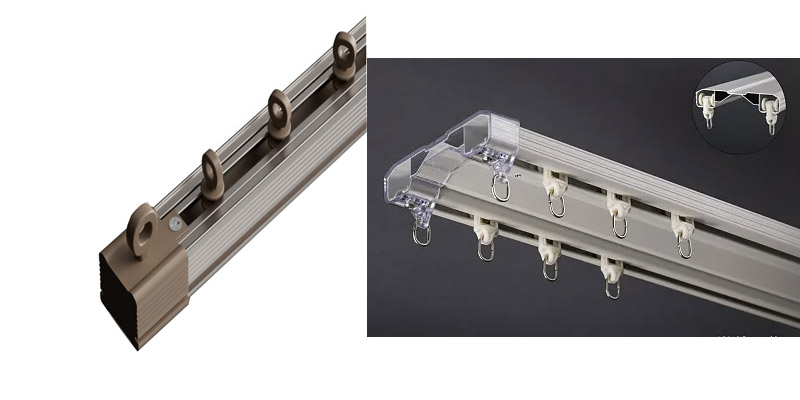
First, take a look at the images to get a sense of the structural differences. On the left is a standard track, with a solid bare inner wall where the nano wheels directly rub against the aluminum alloy. On the right is a track with a silent strip, where a layer of specially made nano-silent strip or sound-dampening rubber strip is embedded in the groove.
Real-Scene Test PK: The “Surprise” Experience in the Bedroom
Late at night, when the family is asleep, you go to draw the curtains. With a standard track—since there’s no cushion—if nano sliders are used, the sliders directly collide and scrape against the aluminum alloy, and the occasional “clattering” sound can be quite noticeable in a quiet environment, sometimes even waking up light sleepers. However, if nano wheels are used instead, the improvement is significant. Another feature is that these tracks are generally thicker, more durable, and often have a higher weight capacity.
Now look at the track with the silent strip. The soft rubber layer acts like a buffer for the sliders, effectively reducing friction. When pulled, you get a light rustling sound, or with wheel-type sliders, an almost silent, smooth glide. For spaces that demand quiet, like bedrooms and studies, the upgrade in experience with a silent track is quite obvious. However, these tracks also have a common trait—many use slider-type runners, which can sometimes be slightly less smooth, and the plastic strip tends to age over time, making overall durability relatively lower.
Thickness and Load Capacity: The Truly Crucial Factors
One thing I want to emphasize: when choosing a silent track, wall thickness and wheel material are even more important than whether it has a silent strip. Some cheap fully enclosed plastic-frame tracks have a wall thickness of only 0.5–0.8 mm, offering relatively poor load capacity, and they tend to deform under heavy curtains. What really lasts is an aluminum alloy track with a wall thickness of ≥1.2 mm, paired with nano wheels, alloy-type wheels, or bearing wheels—only then can load capacity and smoothness be guaranteed. A simple way to judge wheel quality is to slide one inside the track; if it moves quietly and smoothly, it’s a good wheel.
Most Importantly: For Home Projects, There’s No Absolute “Better”—It Depends on Your Needs
Scenarios where a silent track is recommended:
- Spaces that require quiet, such as studies, children’s rooms, and bedrooms.
- Curtains that are relatively light or standard (e.g., linen, sheer fabrics).
- Users who care about detail and prioritize noise reduction.
Scenarios where a standard track works just fine:
- Installed in high-traffic areas like living rooms or balconies, where noise is less of a concern.
- For hanging heavy curtains that put more stress on the track.
- When you prioritize sturdiness and have specific durability requirements.
Adding a silent strip to a curtain track is indeed a practical design choice that enhances the user experience, especially in bedrooms—the extra cost can buy you years of quieter surroundings. However, if what you truly need is durability and stability, a track made of solid, high-quality material is still your best bet.